BLOG
Why Are Banking Apps So Slow? The Spinner Is a Feature, Not a Bug!

You’ve done it. You’re splitting a restaurant bill, everyone’s waiting, you open your bank app and tap “Transfer” — and then it sits there. Spinning. For a full three seconds. On a device with a 5G connection, in 2026, to move two hundred rupees.
Your first instinct is to blame the bank. Lazy engineers. Legacy Java monolith from 1998. Some ancient mainframe gathering dust in a basement. And honestly, you’re not entirely wrong about the mainframe. But the real reason your transfer takes three seconds isn’t laziness — it’s one of the most carefully engineered slownesses in software. The delay is load-bearing. Take it away, and you don’t get a faster app. You get people losing money.
Let’s dig into why.
The Core Problem: Money Is Not a Social Media Post
When you post a photo to Instagram, the stakes of a bug are low. Maybe a like doesn’t register, maybe a comment posts twice. The system can afford to be eventually correct — fix it later, nobody lost anything real.
Money is fundamentally different. When ₹50,000 leaves your account, exactly ₹50,000 must arrive somewhere else. Not ₹49,999. Not ₹50,001. Not the same ₹50,000 twice. And if anything goes wrong in between — a network hiccup, a server crash, a power cut — the outcome must be unambiguous. Either the transfer happened fully, or it didn’t happen at all.
This is not a preference. It is a legal and mathematical requirement. And the mechanism that enforces it has a name.
ACID: The Four Laws of Transactional Money
Every operation a bank performs on your money must satisfy four properties, collectively known as ACID. This isn’t a new concept — it was formalised in 1983 — but it remains the bedrock of every financial system on earth.
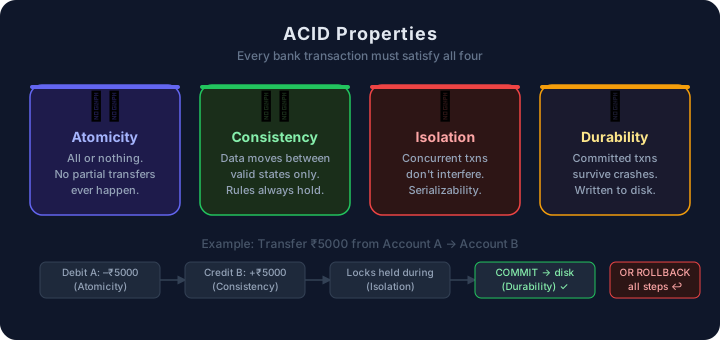
Atomicity means a transaction is all-or-nothing. In a fund transfer, two things must happen: money leaves account A, and money enters account B. Atomicity guarantees that you never get just one of those. If the credit to account B fails — for any reason — the debit to account A is automatically reversed. No partial transfers. No phantom money disappearing into the void.
Consistency means the database moves only between valid states. Your balance cannot go negative (usually). The total money in the system cannot change. Every rule the bank has written — regulatory, mathematical, contractual — must hold before and after every transaction. If a transaction would violate any rule, it doesn’t happen.
Isolation is perhaps the most expensive property to implement. It means concurrent transactions don’t interfere with each other. If you and your employer both trigger operations on your account simultaneously, isolation ensures the outcome is the same as if those operations happened one after the other — not some interleaved mess. Implementing real isolation requires locks — threads of execution literally waiting for each other. Locks take time. Time is the spinner.
Durability means that once a transaction is committed, it stays committed. A server crash one millisecond after you see “Transfer Successful” doesn’t roll back your money. This is enforced by writing to disk — specifically to a Write-Ahead Log (WAL) — before confirming success. Disk writes are among the slowest operations in computing.
Every single transfer you make passes through all four of these gates. That’s where a significant chunk of your three seconds goes.
CAP Theorem: The Impossible Triangle
Banking apps don’t just run on one database. Modern banks are massively distributed — dozens of services, hundreds of servers, spread across multiple data centres for redundancy. And the moment you distribute a system, you run into one of the most fundamental limits in computer science: the CAP Theorem.
CAP states that any distributed data system can guarantee at most two of the following three things:
- Consistency — every read gets the most recent write. Every node agrees on the current state.
- Availability — the system always responds to requests, even if some nodes are down.
- Partition Tolerance — the system keeps working even when network messages between nodes are lost or delayed.
Here’s the uncomfortable part: you cannot avoid partition tolerance in the real world. Networks fail. Cables are cut. Datacentres lose connectivity. A system that simply stops working whenever a network partition occurs isn’t a system — it’s a liability. So partition tolerance is non-negotiable.
That leaves you choosing between Consistency and Availability.
Social networks, search engines, and streaming services almost universally choose Availability (AP systems). Your Twitter timeline might be slightly stale. Your Netflix recommendation might lag. Nobody loses money.
Banks choose Consistency (CP systems). If a network partition occurs between two datacentres, the bank’s system will — intentionally — become unavailable rather than risk the two halves getting out of sync and producing conflicting account states. The app shows you an error. You try again in a minute. That is infinitely better than your account being debited twice, or a transfer succeeding on one datacentre’s ledger and failing on another’s.
The spinner during a partition isn’t the app being slow. It’s the app refusing to lie to you.
Distributed Transactions: When One Database Isn’t Enough
Once you understand ACID and CAP, a harder problem emerges. Banks aren’t a single database. A single transfer might touch:
- Your bank’s core banking system (your account balance)
- The recipient bank’s core banking system (their account balance)
- A fraud detection service (is this transaction suspicious?)
- A compliance service (anti-money laundering checks)
- A notification service (sending you the SMS)
- The NPCI/SWIFT settlement network (inter-bank clearing)
Each of these is a separate system, possibly run by a different organisation, on different infrastructure. How do you make an operation across all of them atomic? If the fraud check passes but the recipient bank is unreachable, what happens to the money already debited from your account?
This problem has two classical answers.
Two-Phase Commit (2PC)
The older approach is Two-Phase Commit. A central coordinator contacts all participating systems in two phases:
- Prepare phase — the coordinator asks every participant: “Can you commit this transaction?” Each participant locks the relevant resources and responds Yes or No.
- Commit phase — if all participants said Yes, the coordinator tells everyone to commit. If any said No, it tells everyone to rollback.
2PC is reliable, but it has a notorious problem: during the prepare phase, every participant holds locks and waits. If the coordinator crashes mid-protocol, participants can be stuck holding locks indefinitely — frozen, waiting for a decision that may never come. In a high-throughput payment system, this is catastrophic for performance.
The Saga Pattern
The modern solution for large-scale distributed transactions is the Saga Pattern. Instead of one giant atomic transaction spanning all systems, a Saga breaks the operation into a sequence of smaller, independent local transactions. Each step publishes an event that triggers the next step.
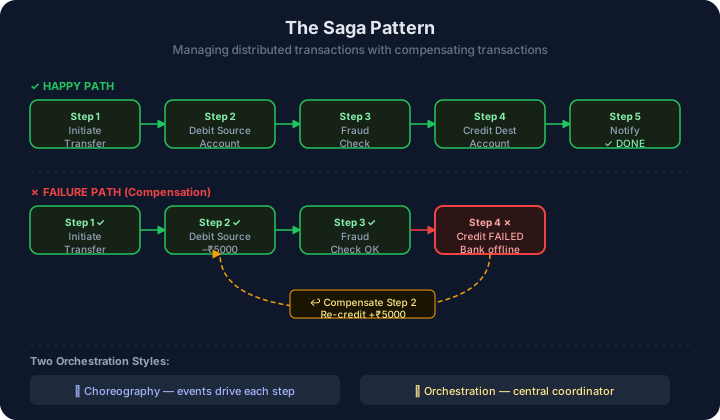
The critical addition is compensating transactions. For every step that can succeed, there is a corresponding “undo” operation defined in advance. If step 4 fails after steps 1 through 3 have already committed, the saga engine executes compensating transactions in reverse order — effectively rolling back the world manually, one step at a time.
There are two flavours of Saga orchestration:
- Choreography: Each service listens for events and reacts accordingly. Decentralised, but harder to debug. “What’s the current state of this transaction?” can be difficult to answer.
- Orchestration: A central coordinator (the Saga Orchestrator) explicitly calls each service and tracks the overall state. More observable, but the orchestrator becomes a point of complexity.
Either way, the saga is asynchronous. Those compensating transactions take time. And crucially — between the time a step commits and its compensation executes — the system is in an inconsistent intermediate state. Saga sacrifices strict ACID isolation for scalability. This is an intentional, carefully managed trade-off.
Regulatory and Audit Overhead
None of the above even accounts for what happens outside your bank’s own systems. Every significant transfer in India passes through NPCI’s infrastructure. International wires go through SWIFT. Each of these networks has its own processing windows, settlement cycles, and latency floors.
Beyond infrastructure, there are legal requirements. Every transaction must generate an immutable audit trail. Fraud models must run in real time. Sanctions lists must be checked. Regulatory reporting systems must be updated. For large transfers — particularly international ones — manual review queues exist precisely because the legal liability of getting it wrong vastly outweighs the cost of making you wait twenty-four hours.
The “T+1” or “T+2” settlement you see on stock trades isn’t technical incompetence. It’s the clearing and settlement infrastructure of an entire financial system processing millions of transactions, netting them against each other, and reconciling the results with regulatory oversight. The technology could be faster. The legal and operational machinery cannot.
Why Can’t They Just Make It Faster?
At this point, a reasonable question is: fine, all of this is real, but surely modern systems can do better than a three-second spinner?
And they can — and have. UPI transactions in India are genuinely fast, often completing in under two seconds end-to-end. That speed was achieved by designing the entire system around these constraints from the ground up: standardised APIs, a single clearing network (NPCI), strict timeouts, and a clear reconciliation protocol. The “slowness” you experience in older banking workflows often reflects systems that were designed in the 1970s and 80s, extended incrementally over decades, and now carry forty years of integration debt.
Migrating a core banking system is one of the most dangerous engineering projects a bank can undertake. Every line of code touches real money. There is no staging environment that perfectly mirrors production at scale. There is no “roll back to the previous version” when the database schema has changed and transactions have processed. Banks move slowly in this domain because the alternative — moving fast and breaking things — means breaking people’s life savings.
The Honest Summary
| What feels like… | What’s actually happening |
|---|---|
| Slow network | Waiting for distributed locks to release |
| Bad app | ACID transaction being committed to WAL |
| Server is old | Saga compensations resolving an intermediate state |
| Bank is lazy | Network partition → system choosing consistency over availability |
| No reason for delay | Fraud model inference + sanctions screening |
The next time you stare at that spinner, know this: it is not nothing. It is a distributed system refusing to give you a fast wrong answer. It is four decades of financial engineering doing exactly what it was designed to do. And as someone who has read this far, you now understand it better than most engineers who haven’t thought about it from first principles.
That spinner is trust. It just has terrible UX.
If this sparked more questions, the rabbit hole goes deep: look into Google Spanner (global CP consistency), the PBFT consensus algorithm, or how Visa’s VisaNet processes 65,000 transactions per second. The engineering here is genuinely remarkable.